Reclaiming Art in the Age of Artifice a Treatise Critique and Call to Action
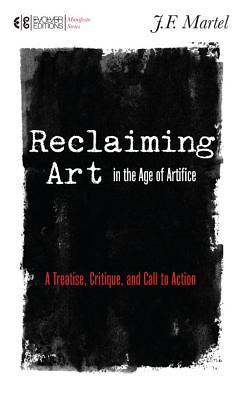
Reclaiming Fine art in the Age of Bamboozlement: A Treatise, Critique, and Telephone call to Activeness
J.F. Martel
Evolver Editions, 2015
208 pages
Claiming powers of prophecy, mystery, and liberation for fine art is distinctly unfashionable in today's cynical, overstimulated earth. In Reclaiming Art in the Age of Bamboozlement, the filmmaker and writer J.F. Martel has set himself the immense, indeed big-headed, task of redefining the role of art for a cataclysmic age saturated in kitsch and the manipulative prototype. That a Canadian has done so — and has provided a virtually unCanadian subtitle for his book — is cause for rejoicing. What Martel has given us is a profoundly of import piece of work that ought to be required reading for every artist in Canada and beyond.
Martel boldly plunges in by beginning his book with a manifesto that'southward a testament to the spiritual forcefulness fields created by fine art. "But through art can man beings express and share the archetypal powers that shape the universe . . . To reclaim it might enable us to recover our organized religion in this world, and act in accordance with that religion for the benefit of life on globe." He goes on to explicitly set out his goal in his preface, describing his book as "an attempt to explore the nature of fine art at the present historical moment" that will — or and so he hopes — instill a deeper appreciation for its unique power also every bit a sense of urgency about making art more central to our lives. He acknowledges the apparent outrageousness of this goal — what tin can art offer usa in the face of today's global challenges? — then answers past claiming a function that only fine art can perform. "Art," he says, summarizing a quote from Proust, "is a meeting identify in which human beings commune at a level that ordinary language and sign systems do not let."
Martel understands every bit few artists exercise that we are undergoing a capitalist colonization of the mind — what he calls "the performance to supplant the dream-infinite of soul and psyche with a fully controllable interface." In an age of information, amusement, and distraction, it is the urgent function of the creative person to reclaim the space of the imagination, to resist the encroachment of mass-manufactured and manipulative dream. Fine art calls the states out of commonsensical mental space into mystery, into acknowledging that we are in the presence of our own unknowability, our wonder and fearfulness at forces greater than ourselves. "Human being consciousness," says Martel, "has access to a powerful otherworld, the identify of dreams and myth, poetry and lunacy." The term he chooses for this otherworld is the "imaginal," coined by the Islamic scholar Henry Corbin to describe the intermediate realm betwixt the man and the divine. Art is thus "a physical manifestation of this imaginal realm in the public sphere, [calling]us back to the source equally a matter of course."
If this linguistic communication seems overwrought to some modern readers, or besides god-influenced, that'due south considering it's difficult to find the appropriate language in our historic period to talk about art. Martel ranges widely in his examples, from the Chauvet cavern paintings to Coleridge, from Stanley Kubrick to Immanuel Kant. He sees art (accurately, in my view) as "paranormal," anomalous. Art asks us to abandon our faith in explanations, "discloses our own mystery even as it lays bare the mystery of consciousness and the mystery of the globe." Where exercise stories come from after all? Every writer is asked this question, and I incertitude any writer has come up with an adequate respond, either for herself or her interlocutors.
Martel also uses the term "the Real," another idiom from Islamic Sufi vocabulary that refers to the unitary creation beyond the illusory veil of the everyday. Art calls us "out of the ordinary and into the Weird." He describes the mutual experience of coming out of the cinema after watching a powerful picture and seeing everything with new immediacy. "It is equally if the film had washed something to the world," Martel says. It hasn't, of form — information technology's done something to us, just since we are each the vehicle of perception for that world, it is the world itself that seems altered. Great art has the ability to open united states to an ecstatic country, lets u.s.a. briefly inhabit the imaginal before coming dorsum, transformed.
Martel argues forcefully against contemporary notions of aesthetic relativism — that all art is culturally determined, and that "art" itself is an elastic term that defies definition. Art, he says, is the outcome of an inborn human drive, what he calls "an objective pursuit with the same merits to truth as science, admitting truth of a different lodge." But if art "penetrate[s]the airtight perimeter of our lives" — the goal of all true art, co-ordinate to Martel — our blah age is well-guarded confronting such date, which is seen as naive and embarrassing. "Every great creative work is a placidity apocalypse," Martel says, quoting Northrop Frye, that "arrest[s]the discursive mind, raising it to a level of reality that is more than expansive than the egoic dimension we normally inhabit. In this sense, art is the transfiguration of the world."
What does Martel mean past bamboozlement? He defines information technology every bit false art that "foregoes the revelatory power that is art's prerogative." Bamboozlement, which includes both propaganda and pornography, is essentially manipulative; it "aim[southward]to make the percipient act, recall, or feel in a sure prescribed manner." By fashion of case, he cites the moving-picture show Avatar providing an artful spectacle in which all emotions, opinions, and conclusions are pre-digested for the audience. All artifice, says Martel, seeks what he calls "a univocal effect, a unmarried meaning." So what? might be the response of many viewers. If such a film provides enjoyment and entertainment, why does information technology thing if it'south mediocre art? Information technology matters because works of artifice reinforce the world of what Martel calls Consensus: "the cloud of received opinions and ideas in which we live." Consensus works against imagination and creativity; manipulates united states of america, instead, into assertive that the reality we inhabit is the only believable one, and legitimates a simplistic binary division of the globe into expert guys and bad guys. The results of such moral simplification are all around us, from the West's obsession with violence and war to its treatment of refugees, the poor, and anyone else w relegated to the category of "loser." Art that cannot face the truth, that is unwilling to tolerate ambiguity, becomes kitsch — what Martel, referring to Milan Kundera's definition, calls "the absolute denial of the 'shit' dimension, the world minus everything we don't like well-nigh it."
Reclaiming Art in the Age of Artifice is not without its flaws. In an era when the discoveries of quantum physics are transforming our cosmic prototype, Martel seems unaware of the implications of this. Breakthrough physicists often speak in language that takes united states very close to the spiritual, reinforcing art's insights by redefining reality. "I recall that modern physics has definitely decided in favor of Plato," says physicist Werner Heisenberg. "In fact, the smallest units of matter are not physical objects in the ordinary sense; they are forms, ideas which can be expressed unambiguously but in mathematical language." The idea of "stuff" — peculiarly solid, motionless stuff — has been completely discredited by mod physics. The illusion of solidity and stability is just that, an illusion created past the limits of our senses. Reality, in other words, isn't existent. The Real — unremarkably attainable just through religion or art — exists behind so-called reality, independent of our senses.
Martel also reasserts the solipsistic and self-serving statement that humans are unique among animals, even while he acknowledges that such a merits is today seen equally arrogant. "Other animals," he says, "practise phenomenal things, but spinning free-floating images of possible worlds from raw psychic material isn't 1 of them." This is a flawed argument even in scientific terms. The fact is, nosotros do non know enough almost animals' internal states to make such a claim. Many of our beliefs about animals — that they don't have language, don't utilize tools, don't have a sense of self — accept all been overturned by actual testify, at least for certain species. And since nosotros know that whales compose songs of immense complication, who's to say they don't have fine art? In the context of a phone call to recollect art's spiritual origins, Martel would practise well to remember that such a devaluing of the animal is antithetical to aboriginal cosmologies.
Reclaiming Fine art works meliorate every bit a treatise and critique than a telephone call to action; Martel himself would probably acknowledge this. Cultural resistance, in fact, is happening in ways that accept us beyond the propaganda of the deed or ideologically driven art forms. The Dark Mount Project in the UK, equally just one example, marks a significant attempt to embody many of Martel's aims: the movement seeks to repossess fine art, specifically writing and storytelling, from market-driven forces by redefining the kinds of stories we need and by providing a vehicle, in the form of biannual anthologies, for stories, essays, poems, and art that speak to that hunger. The online Canadian journal Dark Matter: Women Witnessing, founded 2 years ago, publishes "writing and visual art created in response to an age of massive species loss and ecological disaster. It is a home for dreams, visions, and communications with the nonhuman world — peculiarly those with messages for how we might begin to heal our broken relationship to the world." Aboriginal writers such as Leanne Betasamosake Simpson have written extensively nearly the need for a new relationship of "deep reciprocity" with the land and its inhabitants, homo and other-than-human. Developing such a new relationship requires not only political activity but also acts of re-imagination, including empathy with the Other.
What we are witnessing, I believe, is the ancestry of what James Hillman, in The Dream and the Underworld, calls "[a]move backwards from logos to mythos, this move confronting the historical stream of our culture." Rational logos, so destructively dominant in our Western culture, has led u.s.a. astray past ignoring the intuitive, the instinctive, the intangible in favour of the so-called rational (or, more accurately, rationalization). Martel's book is an essential addition to that growing movement. He directly addresses his fellow artists in the epilogue: "For those of us who make fine art, this ways taking the job seriously enough to pursue the visions that come from inside rather than those that are foisted upon u.s. by social pressures, popular gustatory modality, and the whims of the marketplace." We must, he argues, approach artistic symbols as "living beings" that are not "static objects but dynamic events." In that trip the light fantastic of being lies our but hope of re-envisioning our relationships to each other, and to the cosmos.
Web Sectional
thompsonpriketelle86.blogspot.com
Source: http://notesandqueries.ca/reviews/patricia-robertson-on-j-f-martels-reclaiming-art-in-the-age-of-artifice-a-treatise-critique-and-call-to-action/
0 Response to "Reclaiming Art in the Age of Artifice a Treatise Critique and Call to Action"
Post a Comment